

How to transfer Dollars into Pounds (in 4 simple steps)
If you need to convert Dollars into Pound Sterling and send it to a UK bank account, it comes down to a few basic steps.
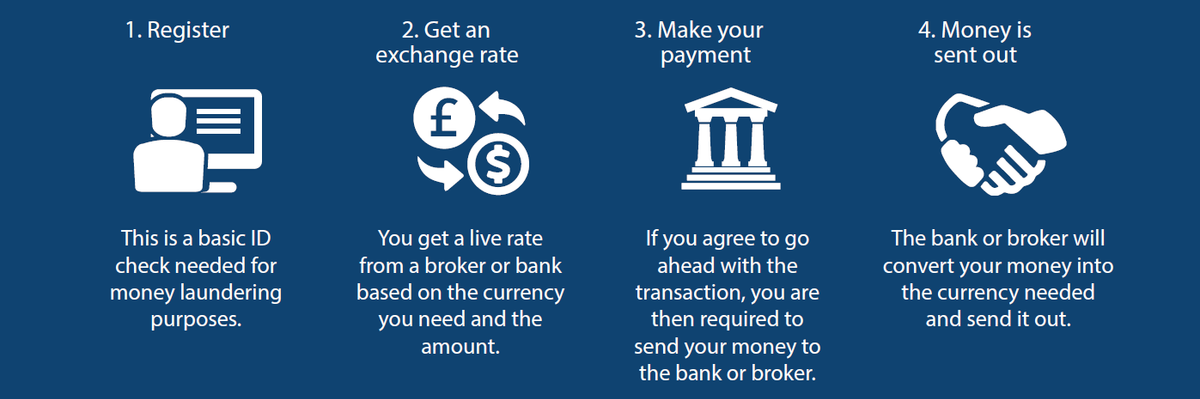
Step 1 – Customer ID check
Before you can send money from the US to the UK, you need to be identified.
All banks and money transfer companies have a legal obligation to verify the sender of the money due to global anti-money laundering regulations.
The check only applies to new customers. Once you’ve been initially checked, you can then skip this step going forward.
It usually doesn’t take long; it can be done within one working day. If you have an address in the UK, it is quicker and easier to verify who you are as US laws are more onerous.
Step 2 – Secure a USD to GBP exchange rate
The USD to GBP exchange rate is actively traded. It moves every few seconds.
A bank or money transfer company will quote you their current rate.
It’s up to you whether you go ahead – you are not obliged to and can wait for another time.
If you are happy to go ahead with the Dollar to Pound rate quoted, the bank or money transfer company will lock in your rate at that point.
You will then receive an email confirming the details of your transaction. It will show the amount of Dollars you have sold (you pay) and the amount of Pounds you have bought (you receive).
Step 3 – Send in your US Dollars
Banks require your Dollars upfront before they will agree on an exchange rate.
However, a money transfer company will allow you to secure a rate before you send the money in. You normally are given 1-2 working days to send the money over.
It can be an advantage doing it this way as you can be more responsive to market opportunities. If you had to pre-pay for your transfer, you could miss out on a great rate waiting around for your money to clear.
On the confirmation email of your transfer, you will be given the bank details of where to send your Dollars.
This is done via a regular bank transfer (US Dollar account to US Dollar account) – so you won’t be charged any international fees from your bank.
Step 4 – Your Dollars are converted into Pounds
Once your money has arrived, your bank or money transfer company will convert your Dollars into Pounds at the rate agreed and send the Pounds to the UK bank account you have requested.
Why banks may not be your best option
If you need to transfer Dollars to Sterling, there’s a good chance your money is currently sitting in a US bank account.
It’s why using your bank might seem like the obvious route to take.
But there are alternatives to the big banks, which you might find are considerably cheaper.
If you think about it, banks have enormous operating costs (billions a year).
Someone has to pay for that.
International wire transfers are not a core product for retail banks. A typical bank branch is focused on mortgages and savings accounts.
If you use a bank for an international wire transfer, it’s likely to be done in batch processing (unless you pay a fee to speed it up). Batching processing is often done only twice a day (morning and afternoon).
A money transfer company specialises in international wire transfers. They are processing transfers in real time throughout the day as they occur.
It stands to reason that payments get there quicker if they are processed quicker.

Costs compared: Banks vs. Money Transfer Companies
Whenever you do an international money transfer, there are two charges to look out for:
- Exchange rates; and
- International wire fees.
1. Exchange Rates
There are no official exchange rates.
A bank or money transfer company will offer you different exchange rates based on the currency you need, the amount you are looking to send.
You can still compare rates by making the same request.
Some US banks will offer better rates if you send larger amounts. For example, Citibank talks about getting preferential rates if you transfer over $100,000.
I noted that some of the US banks boasted on their website that they update their rates daily.
What? Daily?
Are you kidding me?
Exchange rates change every 2-3 seconds in the real world.
Changing your rates once a day is a clear indication that you are way off the market, so the banks don’t need to update their rates more frequently.
When you get an exchange rate quote from a money transfer company it will reflect the fluctuating wholesale rate and include a mark-up (or ‘spread’).
2. International Wire Fees
In addition to the exchange rate, US banks also charge customers international wire fees.
They sometimes go by different names such as international transaction fees.
These tend to be a flat fee on every transfer.
At first glance, these fees may not seem too high.
But if you are sending money regularly or need to send a more significant amount in several tranches, these fees can add up.
And bear in mind, the banks have already made money from the exchange rate, so these fees are an extra charge.
At Key Currency, we don’t charge any transfer fees. Zero.
I know some money transfer specialists do – so it’s something you may need to check.
If you don’t want to pay transfer fees, a money transfer company is normally the best way to transfer Dollars to Pounds.
Overall, using a bank can charge as much as 5%-6% to transfer Dollars to Pounds.
If you are looking to send a large amount, the cost difference can be substantial, depending on who you use.
Beware of daily bank limits
One thing to note is that the big US banks tend to limit the amount of money you can send internationally per day.
Wells Fargo set their limit based on your account history – so it’s hard to comment beyond that.
Bank of America does a similar thing and set a daily limit based on your account type.
For JP Morgan Chase, it’s a $ 100,000-a-day limit.
Frustratingly, it could mean you have to make multiple transfers and pay more fees!
If you transfer a large amount of US Dollars, your bank may limit you, but a money transfer company will not.
Money transfer companies don’t have any daily limits or maximum amounts. So if you need to do a large USD money transfer, you are best off using a money transfer company.

How safe is it to transfer Dollars to Pounds?
If you are transferring Dollars into Pounds, you are likely sending your money to a UK bank account.
One important check is to ensure that the company you use is Authorised by the Financial Conduct Authority (FCA) – the UK’s financial regulator.
The FCA does a similar role to the Securities and Exchange Commission (SEC) in the USA. They establish, monitor and enforce financial rules and regulations.
Authorised and regulated firms are required to keep client money in a separate, safeguarded bank account.
It means your money passes through an account used solely for client transfers, and is not mixed with company funds.
A simple bit of advice – don’t take the risk of using a company that is not Authorised by the FCA.
To find out if a money transfer company is Authorised, you can search for a company on the FCA register.
How to get the best Dollar to Pound rate
We all want to get the best exchange rate possible.
That comes down to paying a small mark-up on the rate, but also trying to execute your transfer at the right time.
Exchange rates are moving around all day.
Even tiny moves in the rate can make a big difference in the amount of Pound Sterling you will get for your Dollars.
For example; a 0.5% move in the USD/GBP exchange rate on a $100,000 transfer is a difference of $500.
A move of that size can be a daily event.
A money transfer company can work with you to get you the best exchange rate available.
If the US Dollar strengthens against the Pound, they can alert you to those opportunities as they arise.
Securing a more favourable rate means more money in your pocket.
Not all money transfer companies will offer you expert help.
Some don’t offer any human contact at all.
That’s because these days a lot of money transfer companies are just online platforms or ‘apps’.
You pretty much have to do it all yourself.
Some of the bigger names in this space are PayPal, TransferWise, CurrencyFair, and Revolut.
They tend to be popular for ‘micropayments’, such as people sending money to relatives or online merchants with lots of small payments to make.
For larger USD transfers, many customers want the peace of mind of having someone they can call at any point.
You may prefer a money transfer company that offers human service and expert guidance.