

How to Transfer Money to Thailand (in 4 simple steps)
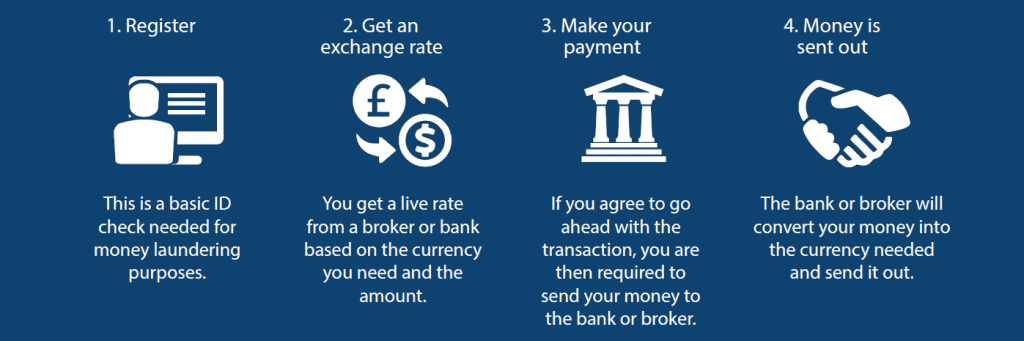
Making a money transfer to a Thailand bank account can be done in 4 simple steps; all you need to do is:
- Register as a client.
- Secure a GBP to THB exchange rate you’re happy with.
- Send your Pounds to the money transfer service you choose.
- Pounds are converted to Thai Baht and transferred.
The Best Ways to Transfer Money to Thailand
Transfer methods available to send money to Thailand; some of the best include:
- International bank transfer
- Debit or credit card payment.
- Apple or Google Pay.
- Cash pick-up services.
- SWIFT payment.
Different money transfer services can provide each type of way to transfer money.
An international bank transfer is one of the most common options. It is one of the safest ways to transfer money to a bank account in Thailand and a great way to get value for your money.
Alternative methods that are done primarily online, like Apple and Google Pay or using your debit or credit card, maybe quicker, but the cost of transfer fees is much higher.
For a more in depth look at international money transfer methods, our dedicated guide provides information about each one!
Best Way to Send Large Money Transfers to Thailand
If you want to send a large amount of money to Thailand (£1,000+), your best option is to use your bank or a currency broker.
Type of Service | Pros | Cons |
|---|---|---|
Banks |
|
|
Currency Brokers |
|
|
Best Way to Send Remittance (small amount) to Thailand
If you want to send a smaller amount of money, or remittance, to Thailand (under £1,000), your options will be between your bank or an online money transfer service, like a money app.
Type of Service | Pros | Cons |
|---|---|---|
Banks |
|
|
Online Money Transfer Service |
|
|
How to Avoid the Main Costs of the Transfer
A vital consideration when transferring money to Thailand is the cost.
The cost of an international money transfer combines both transfer fees and exchange rate charges.
How to Avoid Transfer Fees to Thailand
It is possible to make a money transfer to Thailand with no transfer fees; a few independent money transfer services do not add a transfer fee.
It is worth researching various providers to find ones that only charge for the exchange rate conversion, like ourselves at Key Currency.
High-street banks will charge fixed transfer fees for sending money abroad, especially for transfers outside the European Union, such as Thailand.
Bank transfer fees will vary depending on who you’re with, but the usual range is between £15 to £35 per transaction.
If you want to transfer to Thailand more than once, fixed fees with your bank can start to build up.
Ultimately, don’t use your bank to avoid paying a fee for a money transfer to Thailand.
Real-time Examples of Transfer Fees to Thailand
International Money Transfer Provider | Transfer Fee to Thailand |
|---|---|
Key Currency | £0 |
Remitly | £0.99 |
PayPal | £2.99 |
Wise | £6.48 |
Nationwide | £20.00 |
GBP to THB Exchange Rate Charges (tips on how to find the best)
People tend to think all the costs of a money transfer to Thailand lie with the fixed transfer fees.
However, the exchange rate charge can be even more significant, especially on larger international transfers.
The more money you send to Thailand, the higher the cost will be on the exchange rate, so this is why it is essential to find the best rate available.
You can check today's Pound to Thai Baht rate on the Pound to Thai Baht converter, then use the chart below to see how that rate has moved.
GBP to THB rate = 45.22626419
This data uses the mid-market rate. For an exchange rate on your money transfer, please get a transfer quote.
Again, with a bank, their exchange rates are less favourable for customers, and their charge can be up to 2% more than an independent money transfer company.
Research is critical for keeping costs low for an international money transfer.
A big plus for choosing a currency broker is their support when finding the best exchange rate.
If you’re new to transferring money to Thailand, looking at various rates on offer can be confusing.
Having experts do this for you and guide you is extremely valuable, especially for your money.
For further guidance on costs of international money transfers, our dedicated post will provide you with all of the ins and outs!
How Long Will a Money Transfer to Thailand Take?
An international bank transfer to Thailand from the UK usually takes 2 to 3 days. However, the money getting to the recipient can take longer as it will depend on the receiving bank, so an exact estimation is difficult to predict.
Different money transfer methods will vary in terms of transfer times to Thailand.
Alternatives, like strictly online methods (debit or credit card payment), may see your money arrive faster, but this will be subject to a higher cost for the transfer.
Why could larger transfers take longer?
In our experience, customers looking to transfer a considerable amount to Thailand may experience longer transfer times.
The reason for this is the need to obtain AML (anti-money laundering) documentation to comply with AML laws and regulations in the country, which can be challenging at times.
It is a common occurrence for those looking to build a new property in Thailand instead of buying.
Our expert traders are well-versed in this area and can help move these pains of the process smoothly along.

What Bank Details and Information Do You Need to Provide?
For an international money transfer to Thailand, you will need to provide the following recipient information:
- Recipient’s full name. As stated on their bank account.
- Recipient’s Address.
- Bank account details. Their bank’s name, bank branch code, and account number.
Unlike other destinations, Thailand does not use IBAN codes for international transactions, so the above information is crucial.
For a smoother transfer, ensure you have your recipient’s information accurately.
As well as recipient information, you will also need to provide your banking and personal details.
Are there International Money Transfer Limits to Thailand?
No legal limit exists on how much money you can transfer to Thailand. However, the sender of the funds must provide a reason for the transfer or each transfer sent as the recipient’s bank will have to report this.
It is also worth noting that certain money transfer providers will set daily limits on how much money you can transfer with them.
Most UK banks will also have these limits, usually between £25,000 and £100,000 per day.
Make Sure Your Money is Safe When Sending to Thailand
If you decide to use an independent money transfer service for your transfer to Thailand, the must be FCA-regulated.
FCA stands for the Financial Conduct Authority.
If a company is regulated and authorised by the FCA, this means that your money is always in safeguarded accounts.
Some money transfer companies online aren’t regulated, so looking further into your chosen service is essential.
It’s super simple to know if a company is or isn’t FCA-regulated; you can head to the FCA register and type in their name.