

How to Transfer money to Italy (in 4 simple steps)
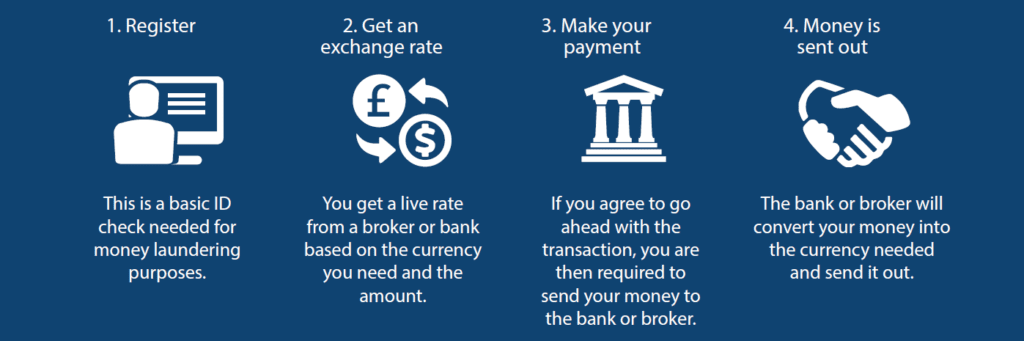
Step 1: Identity check
To transfer money to Italy, firstly you’ll need to pass an ID check to open an account.
This is for anti-money laundering purposes and is necessary wherever you go.
It’s the same for everyone the first time they make an international money transfer.
For UK residents, a copy of your passport and a utility bill is usually enough to prove your identity and set up your account.
Step 2: Secure an exchange rate
When your account’s created, you’re ready to get an exchange rate.
Securing the best exchange rate is the most important part of your currency transfer to Italy.
Remember, there’s no standard exchange rate.
This is why exchange rates vary between international transfer providers.
Get a quote on the Pound to Euro exchange rate from your bank or money transfer provider.
Once you’ve found an exchange rate you’re happy with, you can lock it in.
Be aware, you may need to transfer a percentage of the full transfer amount before you can guarantee an exchange rate.
Step 3: Send in your Pounds
Once you have your exchange rate confirmed and your money transfer to Italy booked, the next step is to send in the full amount of Pounds.
When you book the transfer, your bank or broker will make it very clear where you’ll need to send the Pounds.
After you’ve sent the funds, your part of the money transfer is done.
You can relax and wait for the Euros to land in the recipient account.
Step 4: Your Pounds are converted to Euros
When your Pounds reach the account of your money transfer provider, they will do the currency conversion and exchange them for Euros.
The Euros will then be sent to the Italian bank account as you requested.
Nice and easy!
Cheapest way to transfer money from the UK to Italy
An international bank transfer is usually the most cost-effective way to transfer money to Italy from the UK. It is also one of the most securest too.
Other online alternatives such as debit or credit card payments may see the transfer complete quicker, but this will be subject to higher transfer fees.
In most cases, using your bank for a money transfer to Italy will incur much higher transfer fees and less favourable exchange rates compared to independent money transfer services.
It’s always recommended to do as much research and compare all of the available options and their charges.
Transfer Fee Costs to Italy (compared)
Transfer Provider | Transfer fee to send money to Italy |
|---|---|
Key Currency | £0 |
Xoom | £1.99 |
PayPal | £2.99 |
Wise | £4.49 |
Nationwide | £20 |
How long does it take to send money to Italy?
Money transfers to Italy are generally a quick process.
It normally takes between 1-3 working days to transfer money to Italy from the UK.
The good news for you is that you’re making a transfer to the Eurozone.
Transfers from the UK to Europe are usually straightforward – even after Brexit.
If you’re lucky, you may even find that your money is sent to Italy and completed the next working day.
However, there are no guarantees, and cut-off times to book next-day transfers vary.
Keep in mind that all international money transfers are subject to clearing time at the banks.
The currency exchange itself is usually the quick part of the process!
If you have a deadline, it’s often best to be safe and do the money transfer to Italy in advance so you don’t risk missing it due to any delays in the banking process.

Bank or Currency Broker for a money transfer to Italy?
Your two main options for making an international money transfer to Italy are using a bank or a currency broker.
You’re likely to get a better exchange rate using a currency broker.
Although banks are familiar names, they’re not designed to make large currency transfers cheap or efficient.
They’re focused on mortgages, loans, and credit.
It’s obvious when you see how expensive their exchange rates are.
There’s no need for international transfers to cost this much – familiar name or not.
That’s without taking any extra transfer fees into account.
On the other hand, currency brokers are also known as money transfer specialists, and this should give you a clue as to what sets them apart.
They’re more efficient than banks and you can get better exchange rates.
The bottom line, sending money to Italy is easier and cheaper for you when you use a currency broker.

How to avoid paying fees when transferring money to Italy
Many UK high street banks will charge additional fees when sending money to Italy.
It seems to be such a regular occurrence, that people have come to expect hidden fees to be sprung upon them (usually at the very last minute!) for their international transfers.
As if an extortionate exchange rate margin wasn’t enough, they have the cheek to add more costs every single time you make a transfer.
Why should this be the norm?
In my opinion, it shouldn’t.
Some currency brokers, like ourselves, don’t charge additional fees.
At Key Currency, all our costs are built into the exchange rate quote.
That way, it’s clear exactly how much your transfer to Italy will cost, and you’ll always know exactly how much will be received at the other end.
We believe that’s much better for you.
How safe is a currency broker?
When transferring money to Italy, you want to know that you’re using a company you can trust and that your money is safe.
You want to ensure the company you use is Authorised by the Financial Conduct Authority (FCA).
FCA-Authorised currency brokers must keep all customer funds in a separate and safeguarded bank account.
Checking that a currency broker is on the FCA register is the best way you can ensure your money is safe while sending money from the UK to Italy.
How to get a great exchange rate for your money transfer to Italy
Exchange rates change every few seconds.
As a result, we often see large movements in exchange rates over days, weeks, or months.
Movements of 1% happen all the time. It could easily change 1% over a week.
Those week-to-week 1% pound to euro moves show up clearly on a live GBP to EUR chart.
GBP to EUR rate = 1.17893842
This data uses the mid-market rate. For an exchange rate on your money transfer, please get a transfer quote.
Use the buttons above the chart to look at different time periods, or check the live GBP to EUR converter for the latest mid-market rate.
In a perfect world, everyone would put in the time and effort to become experts in the latest exchange rate trends.
But keeping in the know isn’t easy.
We’re all busy people with better things to do than study exchange rate graphs all day.
This is where it pays to get some guidance with your transfer.
Pro-active currency brokers watch the markets for you and can even let you know when the market moves in your favour and when it is the right time to transfer money to Italy.
This separates currency brokers from cumbersome high-street banks and makes them more helpful than online-only apps.
Online services like Wise or Revolut make you do every aspect of international transfers yourself.
For large transfers, why risk losing money by making the transfer at a time when the exchange rate has moved against you?
Plus, if something were to go wrong using an app, there’s nobody for you to contact and you’re left staring at your phone screen.
I’d want an expert on my side.
Using a currency broker, you’ve always got someone at the end of a phone who has dealt with your transfer from start to finish to answer your questions at a moment’s notice.
This takes the stress out of transferring money to Italy.