
GBP to AUD Forecast
Our forecast: We expect the Pound to Australian Dollar exchange rate to weaken slightly over the remainder of 2026, with GBP/AUD ending the year at around A$1.87.
The Pound is currently trading at around A$1.91 against the Australian Dollar.
This is considerably lower than the levels above A$2 seen earlier in 2026.
One of the main reasons has been the changing outlook for Australian interest rates.
The Reserve Bank of Australia has raised interest rates three times this year, taking its cash rate to 4.35%.
By comparison, the Bank of England’s base rate currently stands at 3.75%.
Higher Australian interest rates can make the Australian Dollar more attractive to international investors.
Will the Pound rise against the Australian Dollar?
Our view is that the Pound is more likely to weaken than strengthen against the Australian Dollar during the remainder of 2026.
The Reserve Bank of Australia has indicated that another interest rate rise remains possible if inflation stays too high.
This contrasts with the UK, where interest rates are currently lower and the Bank of England faces a difficult balance between controlling inflation and supporting economic growth.
The Australian Dollar can also benefit when commodity prices and the global economy are performing well.
Australia is a major exporter of commodities including iron ore, coal and natural gas. Strong demand for these exports can increase demand for the Australian Dollar.
However, there are risks to this forecast.
A slowdown in the Chinese economy could negatively affect demand for Australian exports. Global economic or political uncertainty can also hurt the Australian Dollar, as investors tend to favour currencies such as the US Dollar during periods of heightened risk.

GBP/AUD forecast for the rest of 2026
Our central forecast is for GBP/AUD to end 2026 at approximately A$1.87.
We expect the exchange rate to remain broadly between A$1.84 and A$1.94 over the remainder of the year.
Period | Key Currency GBP/AUD forecast |
|---|---|
Current rate | ~A$1.91 |
1 month | A$1.88–A$1.93 |
3 months | A$1.86–A$1.92 |
End of 2026 | ~A$1.87 |
Main risk to forecast | Australian interest rates and global growth |
GBP to AUD weekly forecasts (tips and tools)
Exchange rate forecasts depend on the window of time you are looking at.
For example, you can have positive short-term indicators alongside negative long-term indicators. The two can co-exist.
Forecasting always depends on your time frame.
Over shorter time frames – hours, days and weeks – there’s only a small number of things that can affect the GBP to AUD rate. It means you can narrow down your focus.
To keep track of upcoming news, take a look at the DailyFX economic calendar.
While there are plenty of other free economic calendars, I prefer this one because of its clear layout and that each piece of data is given a low, medium, or high level of importance.
I tend to disregard the low and medium-impact events and just concentrate on those with a high impact.
As currency brokers, we will look at the calendar and may hedge the risk before an important event.
If you are cautious by nature or cannot afford the GBP/AUD rate to move against you, it makes sense to convert your money ahead of a risk event.
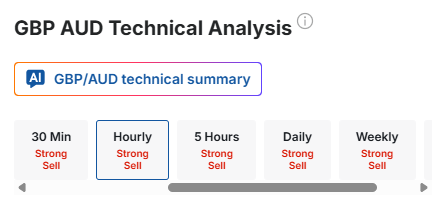
Another popular way of looking at GBP/AUD trends and forecasts is to use technical analysis.
This involves using price patterns to identify trends and predict future exchange rate movements.
You can get a feel for the latest GBP/AUD technical analysis here.
Select the timeframe you want. The selected period is outlined in blue, and it shows whether it's a Buy (GBP to rise) or a Sell (GBP to fall).
I appreciate not everyone has the time or knowledge to analyse exchange rates.
You might find it easier to speak to someone that follows this day in, day out.
Ay Key Currency, part of our service is to help guide you on exchange rate trends and market opportunities.
GBP to AUD forecast long-term (some practical advice)
Longer periods call for a different approach to forecasting.
Short-term news becomes irrelevant. Bug themes have time to play out.
My view is that there are so many factors that could affect longer-term GBP/AUD rates that you are best to focus on historical reference points to guide your timing.
From a practical point of view, I would look at historical rates using a GBP/AUD chart – 1 year and 5 years will give you a good enough perspective.
The live chart below goes up to one year. Use the table under it for recent highs, lows and the average.
GBP to AUD rate = 1.90548995
This data uses the mid-market rate. For an exchange rate on your money transfer, please get a transfer quote.
To convert an amount at today’s rate, use the Pound to Australian dollar converter.
Look to identify areas of support (troughs) and resistance (peaks), as well as the current underlying trend.
You may also find it useful to speak to a foreign exchange broker who is watching rates continuously throughout the day.
It’s something we offer are part of our money transfer service.