

To transfer money from Cyprus to the UK, you can use either a bank or a money transfer specialist.
I’ll explain the process, how long it takes, the costs, and how to avoid paying high charges.
Alternatively, if you’re looking to send money to Cyprus, click through for more information on that transfer!
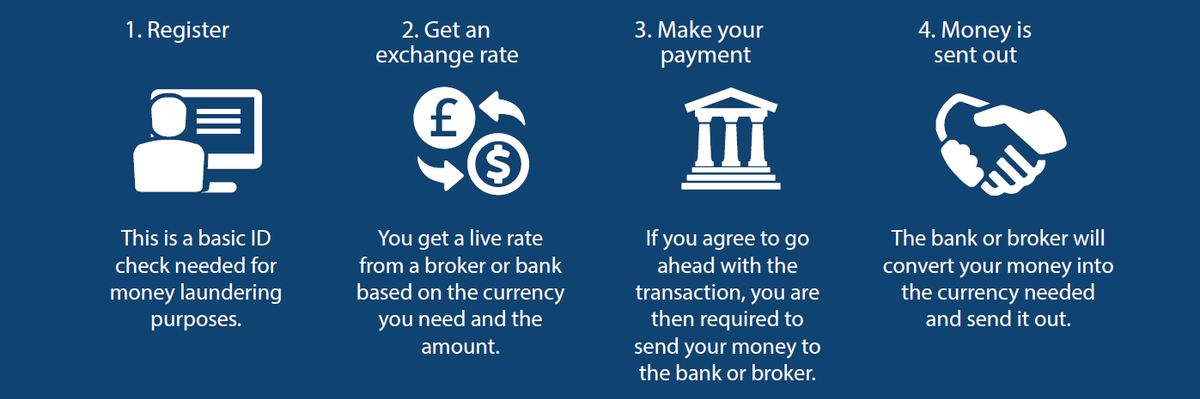
How to transfer money from Cyprus to the UK (in 4 steps)
Sending money from Cyprus to a UK bank account is not complicated once you understand how it works.
Step 1 – Identity check
Before you can send money internationally, all new customers are required by law to have an ID check.
This is due to global anti-money laundering regulations.
Most people can be verified pretty easily – the most common way is by passport number and driver’s licence (or a recent bill).
Step 2 – Secure an exchange rate
Once the ID check is done, you can secure an exchange rate if you wish.
To send money from Cyprus to the UK, it is the Euro to Pound exchange rate that matters.
Whenever you’re ready, a bank or money transfer specialist will quote you their latest EUR to GBP rate.
You are not obligated to accept that rate if the time is not right for you.
The live euro to pound rate is below, with ranges from a day to a year.
EUR to GBP rate = 0.83397999
This data uses the mid-market rate. For an exchange rate on your money transfer, please get a transfer quote.
Use it to see if the euro looks stronger or weaker against the pound than it has recently, before you lock in a rate.
No transaction will happen without your authority.
If you are happy to go ahead at the rate quoted, the exchange rate is locked-in.
You should also receive a confirmation by email showing all the details of your transaction.
Step 3 – Send in your Euros
A bank will require you to have the Euros in your account upfront, whereas a money transfer company will allow you to secure an exchange rate before you send your Euros in.
If you are using a money transfer company, the confirmation email will have the details of where they send your funds.
This will be to a designated client bank account.
You will also need to provide the details of the UK bank account where you want your funds sent.
Step 4 – Your euros are converted to pounds and sent to the UK
Once your bank or money transfer company has received your Euros, they will be converted into Pounds at the exchange rate previously locked-in.
Your Pounds are then sent to the UK bank account you’ve requested.
That’s it.
Banks vs money transfer specialists – what’s the difference?
Both banks and money transfer specialists use the same SWIFT payment system.
So the method of payment is the same.
The main differences are to do with cost and service.
Banks are generally a more costly option.
However, for small payments, you may consider it more convenient to use a bank in Cyprus.
For larger international payments, it makes financial sense to consider using a money transfer company.
The overriding feedback I have had from customers is that banks charge a lot and can be frustrating to deal with.
As you probably know, the bank branches in Cyprus are only open for some of the day, and most shut early afternoon (around 1.30 pm-2.30 pm).
You queue up only to find the staff member doesn’t know much about making an international transfer.
Then, once you complete all the paperwork, you won’t hear from anyone again and have to hope and pray your money arrives in the UK.
You get the impression that the banks want you to do everything yourself online these days.
Yet at the same time, banks restrict the amount of money you can send online.
This makes it difficult for someone wanting to send a large amount of money to the UK.
Money transfer companies don’t tend to have any limits on the amount of money you can transfer – which makes them a more flexible option.
There are also some extra service features offered by money transfer specialists.
Some will allow you to fix or guarantee the exchange rate for an agreed period (known as a forward contract), let you set specific limits on the rate, or inform you when the rate swings in your favour.
Pros | Cons | Best for | |
|---|---|---|---|
Bank | Can use your existing account | High charges, minimal service | Small payments, convenience |
Money transfer specialist | Lower cost, more efficient | Need to register | Large or regular amounts |
The charges explained (including the hidden ones)
When you transfer money from Cyprus to the UK, there are two types of charges:
- Fees
- Exchange rate
1. Fees
A lot of people think the fees are the only charge.
I see it mentioned on expat discussion boards all the time: “My bank charges me €20 to send money back to the UK” etc.
That’s not true.
They are referring to the basic transaction fee charged by banks.
Below is a quick overview of fees charged by the two largest banks in Cyprus:
- Hellenic Bank charges a ‘creation fee’ based on the number of Euros sent at 0.15% with €20 min, €250 max (branch) or 0.10% with €10 min, €200 max (online). These are for an Outgoing Transfer in a standard personal account.
- Bank of Cyprus charges a ‘processing fee’ of €15 (branch) or €10 (online). There is an additional SWIFT fee of 0.05% with €20 min, €200 max.
But banks can also add other fees.
Expect to pay another €30 to €50 if you need an urgent payment.
You may also get hit with “correspondent” fees, which is a fee from the bank receiving your money.
Bank of Cyprus charges a €12 to €60 correspondent fee depending on the amount you send.
It’s not easy to anticipate the total fees a bank will charge because their schedules of tariffs run for 15+ pages.
There is a simple way to bypass these fees…don’t use a bank.
2. Exchange Rates
If you’re new to money transfers, you might think exchange rates are roughly the same wherever you go.
That’s not the case.
Every bank and money transfer specialist set their own exchange rates.
For larger money transfers, the exchange rate is normally a lot more important than the fees.
That’s a lot more than a couple of hundred euros in fees.
On a large money transfer, the exchange rate costs dwarf the bank fees.
It’s why I always suggest getting an alternative quote.
In my experience, the major banks in any country usually charge uncompetitive exchange rates because they know many customers will automatically use their services no matter what.

Are there restrictions on getting money out of Cyprus?
Although there are no foreign exchange restrictions between Cyprus and the UK, problems still exist in getting money out of the country.
Back in 2013, Cyprus imposed capital controls to avert a banking crisis, but these restrictions were removed in 2015.
However, as British expats have discovered, it can still be a lot easier to send money from the UK to Cyprus than it is to send money from Cyprus to the UK.
It’s to do with anti-money laundering rules.
Unfortunately, innocent British expats get dragged into this mess.
All that’s needed is a common-sense approach.
If you are a British expat, there is nothing wrong with moving your money to the UK once the standard ID checks have been done, particularly on property sales as there is a clear legal trail of the transaction.
How safe are money transfers between Cyprus and the UK?
Given the size of the British expat community in Cyprus, sending money back to the UK is a well-trodden path.
However, there are some things to consider before choosing a money transfer provider.
My recommendation is to select a company that is fully regulated by the Financial Conduct Authority.
A regulated company must process customer funds through a segregated client bank account to keep the money safe.
Most of the leading money transfer companies are regulated in the UK by the Financial Conduct Authority.
You can check their validity by entering their name on the FCA register.