

Transferring money from France to the UK is relatively simple, but the costs and services provided will vary depending on whether you use a bank or currency broker.
If you’re wanting guidance on transferring money to France from the UK, click through for more information on that transfer!
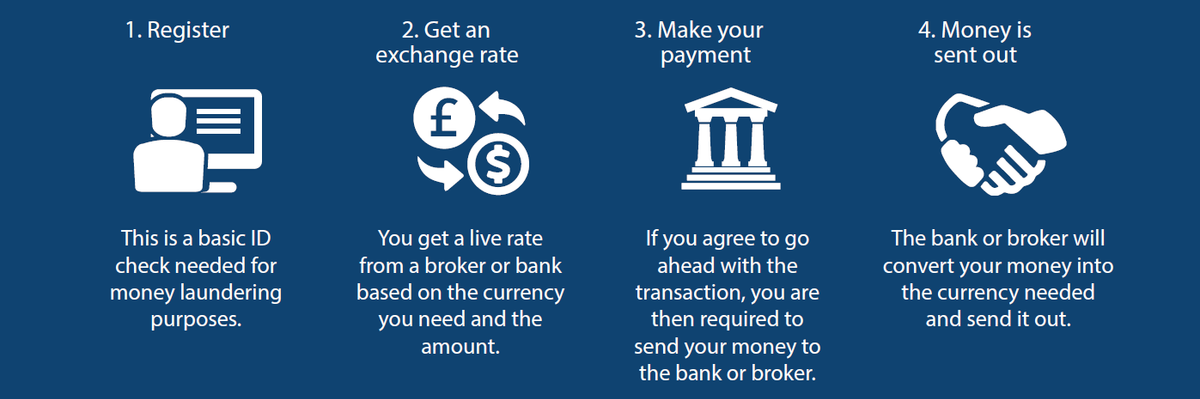
How to transfer money from France to the UK (in 4 simple steps)
Step 1 – Identification check
Before you can transfer money to the UK, you need an identification check.
It is required by law.
It’s a fairly straightforward process.
You need to provide the usual – a copy of your passport and a recent utility bill or bank statement.
A lot of people just take a quick photo with their phone or iPad and email it over.
Step 2 – Secure a EUR/GBP exchange rate
When you transfer money from France to the UK, it is the EUR/GBP rate you need.
The EUR/GBP rate moves every few seconds, so the rate won’t stay the same for long.
Once you receive an exchange rate quote, you can decide whether to go ahead or not.
If you are happy to proceed, your bank or money transfer specialist will lock in your rate.
You will then be emailed a confirmation of your transaction, showing the number of Euros you have sold and the number of Pounds you will receive.
Step 3 – Send in your Euros
Before any money is converted, you need to send in your Euros.
This is done via a normal bank transfer.
On the confirmation email, there will be the bank details of where to send your money.
Step 4 – Your Euros are converted to Pounds
Once your bank or money transfer specialist has received your Euros, they will convert them into Pounds at the rate agreed upon and transfer them to the UK bank account you have requested.
On the move? … Here’s a 3-minute video summary
The best way to transfer money from France to the UK
Transferring money from France to the United Kingdom by bank transfer is one of the best options. It is cheaper and more secure than other online alternative methods (credit or debit card). An independent transfer service or your bank can make this transaction. To avoid high fees and get better exchange rates, an independent provider will be the better option.
In days gone by, people would have automatically headed to their bank.
However, times have changed.
Today, there are often cheaper options.
The exchange rates set by banks just aren’t competitive or very responsive to the market.
In my opinion, that’s excessively high.
Before you transfer your money, it makes sense to get an alternative quote.

What bank details are required to transfer money from France?
To transfer money to the UK from France, you will need to provide details about the UK recipient bank account.
The main part here is providing the IBAN.
An IBAN is also known as an ‘international bank account number’.
UK IBANs consist of 22 characters which is a combination of numbers and letters.
It will include:
- 2-letter country code (GB)
- 2 number check code
- 6 number sort code
- 8 number account number
You or your recipient will be able to find the required IBAN number on a bank statement or by logging into online banking.
You can also ask your bank for this or money transfer specialists will help you set up this part of the money transfer from France.
We’ve now created an IBAN checking tool for those looking to send money to the UK from France. It will let you know if you have put in the right details and if the IBAN is valid.
How to choose a currency broker for your money transfer from France
Currency brokers specialise in international money transfers.
They are also called money transfer companies.
Broadly speaking, they fall into two categories.
The first is online-only platforms or apps, such as Transferwise, PayPal, CurrencyFair, and Revolut.
These are particularly popular for smaller amounts (under £5,000) because the only customer support you get is via email or web chat.
You are left to decide whether it’s the right time to transfer your money.
This can be daunting if the amount you are transferring is large.
The second is full-service currency brokers who provide a human touch alongside their payment technology.
They can not only help you with the timing of your transfer but check over the details such as the payment information to make sure everything goes smoothly.
For larger amounts, many customers want the peace of mind of having someone they can speak to, and that can offer assistance and guidance on rates.
Currency brokers, such as Key Currency, can also monitor exchange rates for you.
It may be you have a specific exchange rate you wish to aim for, or simply want a second opinion on current market rates.

How safe is it to transfer money from France with a Currency Broker?
One of the questions we get asked a lot is whether it’s safe to use a currency broker.
I completely understand. I’ve been a customer too.
The one thing I would suggest is you use a currency broker that is authorised and regulated by the Financial Conduct Authority (FCA)
The reason is important.
An authorised company is required to transfer customer money through separate and safeguarded bank accounts used solely for client transactions.
As long as you choose an FCA authorised currency broker, your money transfer will be conducted through a safeguarded client account.
Beware of misleading online exchange rates
You have probably seen there are quite a few websites, such as XE and Oanda, that provide live exchange rates, news, and charts.
But there’s a fundamental problem.
As the name suggests, interbank rates are used by banks to trade with other banks.
Not even large corporations that trade several hundred million in foreign exchange can achieve the interbank rate.
It’s misleading for consumers who want to make real plans with their money.
The solution is to get a real quote from a genuine provider.
Selling a French property?
For a property sale in France, you might have a period of 1-2 months between exchange and completion.
As you probably know, property transactions can take a while in France. But that time is essentially a window of opportunity to get the best exchange rate possible.
Over a few months, exchange rates will typically move between 1%- 5%.
To put that into perspective, if you sell your French property for €150,000, you could be €1,500 – €7,500 better or worse off depending on the exact timing of your transfer.
It shows how fluctuations in the EUR/GBP exchange rate can make a big financial difference.
The live EUR to GBP rate below, with ranges from a day to a year, shows the shorter moves that sit inside that 1%–5% window.
EUR to GBP rate = 0.84971019
This data uses the mid-market rate. For an exchange rate on your money transfer, please get a transfer quote.
One thing a lot of people don’t know is that you can lock in an exchange rate in advance of your expected completion date.
In the case of a property sale, it means you can secure a rate once you have exchanged.
This is done using a ‘forward contract’.
It allows you to fix a rate for up to 12 months ahead.
A forward contract enables you to take advantage of a favourable move in the Euro.
It also means you know exactly how much you will receive in Pounds Sterling ahead of the completion date.
This can give customers peace of mind and allow them to budget more effectively.
You may also wish to read our Practical Advice for Selling Your Property in France.