

How to transfer money to the USA (in 4 simple steps)
It might seem daunting to send money from the UK to the USA, but in practice, the process is extremely quick and easy.
Here’s how it works…
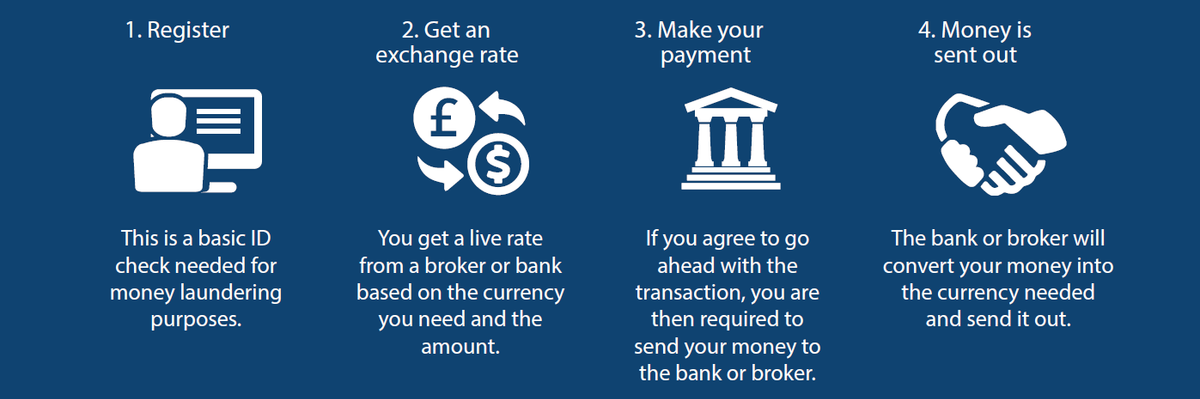
Step 1: Register
All new customers must register to comply with anti-money laundering rules.
It is a legal requirement to identify a person before they can send money overseas.
Fortunately, this is normally straightforward and can be done the same working day (sometimes in under an hour).
Most people can be identified quickly and easily through basic details such as their name, address and passport number.
Step 2: Secure a GBP to USD exchange rate
Once you are registered, you are in a position to lock-in a GBP/USD exchange rate if you wish.
At any time you can request the latest rate.
No transaction will take place without your consent to go ahead.
If you are happy to proceed with the US Dollar rate quoted, your bank or money transfer service will lock-in your rate.
You will then be emailed a confirmation of your transaction, with the amount of US Dollars you have bought and the amount of Pounds you have sold.
Step 3: Send in your Pounds
Your bank or money transfer service will provide you with the bank details of where to send your Pounds.
For most people, this will involve a regular domestic bank transfer (UK bank to UK bank) – like paying a bill.
Step 4: Your Pounds are converted to US Dollars and sent out
Once your your bank or money transfer service have received your Pounds, they will convert them into US Dollars at the exchange rate agreed and send your money to the US bank account you’ve requested.
That’s it in a nutshell.
One thing to note – an international money transfer is basically the same thing as a wire transfer or telegraphic transfer. Different places use different jargon.
What information do you need?
Before you can send money to the USA, you need to provide details about where you want your money sent.
Here’s the recipient information you need:
- Name of recipient
- Account name
- Routing number (9 digits)
- Bank account number (10-12 digits)
The US bank account can be in your name or the name of a ‘third-party’, such as a relative, business, or lawyer.
If you’re unfamiliar with a routing number, it is a 9-digit code that identifies where you opened your bank account in the United States.
A routing number is also sometimes called an ABA or RTN (don’t you hate financial jargon).
The routing number can be found as the first digits in the bottom left-hand side of a cheque.
Your account number will usually be 10-12 digits long and is the second set of numbers running along the bottom of a cheque.
You can also get this information by logging into the bank account or asking in a branch.
If you are concerned about getting all the details right, a money transfer specialist can help check things over for you.

Bank or money transfer specialist – what’s the difference?
In days gone by, people had little choice but to use their bank to send money to the USA.
Fortunately, the ‘banking cartel’ on foreign exchange is over.
Money transfer specialists are a cost-effective and efficient alternative to using a bank.
There is no doubt a convenience to using your bank because normally they are holding your money already.
But speaking from my own experience, I’ve found the banks charge more and make you do most of the work.
The total cost is a combination of fees and exchange rates.
Transfer Fees
The most common type of fee incurred is a transfer fee.
Transfer fees are typically a flat fee charged by the banks on every international transfer.
While the transfer fees are annoying, the real money is made from the exchange rate.
Exchange Rates
As a general rule, banks can charge up to 3%-5% in exchange rate costs to send money to the USA.
The exact percentage depends on the amount you’re sending.
As money transfer specialists have much lower overheads, they can undercut the banks on both fees and exchange rates.
The savings can be substantial.
If you know how much you want to send, it’s best to make a direct comparison with your bank.
I would also suggest making a comparison at roughly the same time as exchange rates change throughout the day.
5 reasons you shouldn’t use your bank
- It’s not their area of expertise
- Their exchange rates are uncompetitive
- Banks charge you various fees
- They won’t help you with the timing of your transfer
- You are not their priority
Why you can’t trust online exchange rates
These days it’s easy to get an exchange rate online.
There’s a whole bunch of foreign exchange websites, such as XE, DailyFX and Oanda, that display live rates.
But if you look close enough on these sites, you will find a disclaimer revealing that the rates shown are “not available to consumers” or “for informational purposes only”.
Interbank rates are used by banks to trade with other banks.
I’ve also found a lot of comparison sites aren’t reliable.
The rates I’ve seen quoted on comparison sites are usually non-binding, which makes me think they are basically ‘teaser rates’ to get the click.
Some of the leading comparison sites also quote you on weekends and public holidays, but the currency markets aren’t even open! What does that tell you?
To me, it’s irrefutable proof the rates aren’t real.
An alternative is to get an exchange rate directly from the source and cut out the middleman.
At least that way you can better plan your future by using a genuine rate.

How to achieve a better exchange rate for money transfer to US
The GBP to USD exchange rate changes every 2-3 seconds throughout the day.
While the moves might look small, even tiny moves in the rate can make a big financial difference.
It’s quite common to see daily moves of 1%.
And over weeks and months, the swings can move considerably more.
The point is that good timing can significantly reduce the cost of your transfer.
The chart below shows how sterling has traded against the dollar from a day out to a year, which can help you judge whether now is a decent moment to send money to the USA.
GBP to USD rate = 1.33183965
This data uses the mid-market rate. For an exchange rate on your money transfer, please get a transfer quote.
For the longer view, the historic pound to dollar page tracks how the pair has moved over the years.
However, banks and online-only platforms won’t give you an help you with the rate.
Whereas, some money transfer companies, such a Key Currency, provide exchange rate guidance as part of their service.
A money transfer service can monitor the market for you and let you know when the rate moves in your favour.
The best way to transfer money from the UK to the USA will depend on whether you are comfortable doing everything yourself or if you would rather get some market guidance.
We have have further guidance about the GBP to USD rate forecast, if you need more information!