
IBAN transfers are a vital solution should you find yourself needing to transfer money internationally.
If you have never made an international bank transfer before, it’s likely you will have many questions about how an IBAN transfer works, and how long it will take to process.
In this article, we’ll take an in-depth look at how IBAN transfers work, the time they take, and how to make the whole process as simple as possible.
What is the average time it takes for an IBAN transfer to take?
The time taken for an IBAN transfer depends on variables such as the countries, banks, and time zones involved.
An international IBAN bank transfer typically takes between 1 to 5 working days. As a general rule, IBAN transfers within Europe are quicker than transfers across different time zones. The time taken also depends on bank verification processes.
Here are some helpful comparisons of average times between different countries:
UK to USA
1 to 3 working days.
It typically takes 1 to 3 working days to transfer money from a UK to a US bank account. The time taken varies because different US banks are often slower than others at clearing your funds.
UK to Spain
2-3 workings days.
Sending money to Spain from the UK usually takes 2-3 working days. The Spanish bank receiving the funds will need to do their own internal checks before they clear your money into the account.
UK to Australia
3-4 working days.
An IBAN money transfer to Australia by your bank takes around 3-4 working days for your money to arrive in Australia.
UK to Canada
2-3 working days.
It usually takes 2-3 working days for your Pounds to arrive in Canada using an IBAN transfer service.
How an IBAN transfer works
An IBAN transfer should be a straightforward process, and is conducted in just a few easy steps.
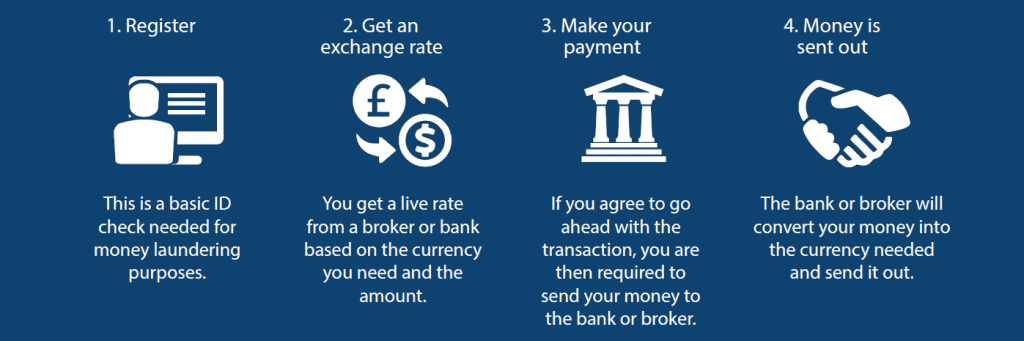
Firstly, you as the sender instruct your bank to start the international transfer process, and provide the recipient’s IBAN number.
For example, in Spain the IBAN has 24 characters, comprising our full account number preceded by 4 other characters. The first two are the country code (ES) followed by two check digits.
A Spanish IBAN number will something like this – ES91 2100 0418 4502 0005 1332.
Your bank will then clarify this account information and process the transfer request. The funds are then debited from your account and sent directly to the recipient’s specified bank.
When the funds are received, they credit the amount to the relevant account. The transfer is completed when the recipient’s bank credits the account balance and verifies the funds that have been sent.
The IBAN transfer process is recognised as they best way to carry our secure and accurate transactions between individual banks across international borders.

What can cause delays with IBAN transfers?
There are several different factors which can potentially delay an IBAN transfer. The main reasons are as follows:
Currency Conversion
When the transfer is being made between different currencies, for example, Pounds to Euros, the transfer will require currency conversion.
The time your bank takes to convert the currency can cause a delay in the transaction time.
Working Days and Time Zones
Of course, we have to remember that all banks adhere to their local time zones and therefore working days.
If the IBAN transfer is sent at the weekend, or before a bank holiday in the time zone of either the senders or recipients bank, the transfer time is affected by the non working days.
Internal Payment Process
Both the sender’s bank and the recipient’s bank will most likely operate with different payment processes or internal procedures such as additional verification measures, which may again affect the transfer time.
Fraud Prevention Measures
For compliance reasons, all banks have to ensure they have strict security checks to avoid any fraudulent activities.
Should a transaction appear to be suspicious for any reason, it may undergo additional checks and verification, resulting in delays.
What Happens if an IBAN Transfer can’t go through?
In our experience it is rare, but on occasion, an IBAN transfer can potentially have issues which can prevent it from being completed.
In the event that this should happen with your IBAN transfer, the funds are typically returned to the sender’s account.
Our top tip is to thoroughly check the details of the recipient’s IBAN, as one incorrect digit can lead to the transfer being rejected.